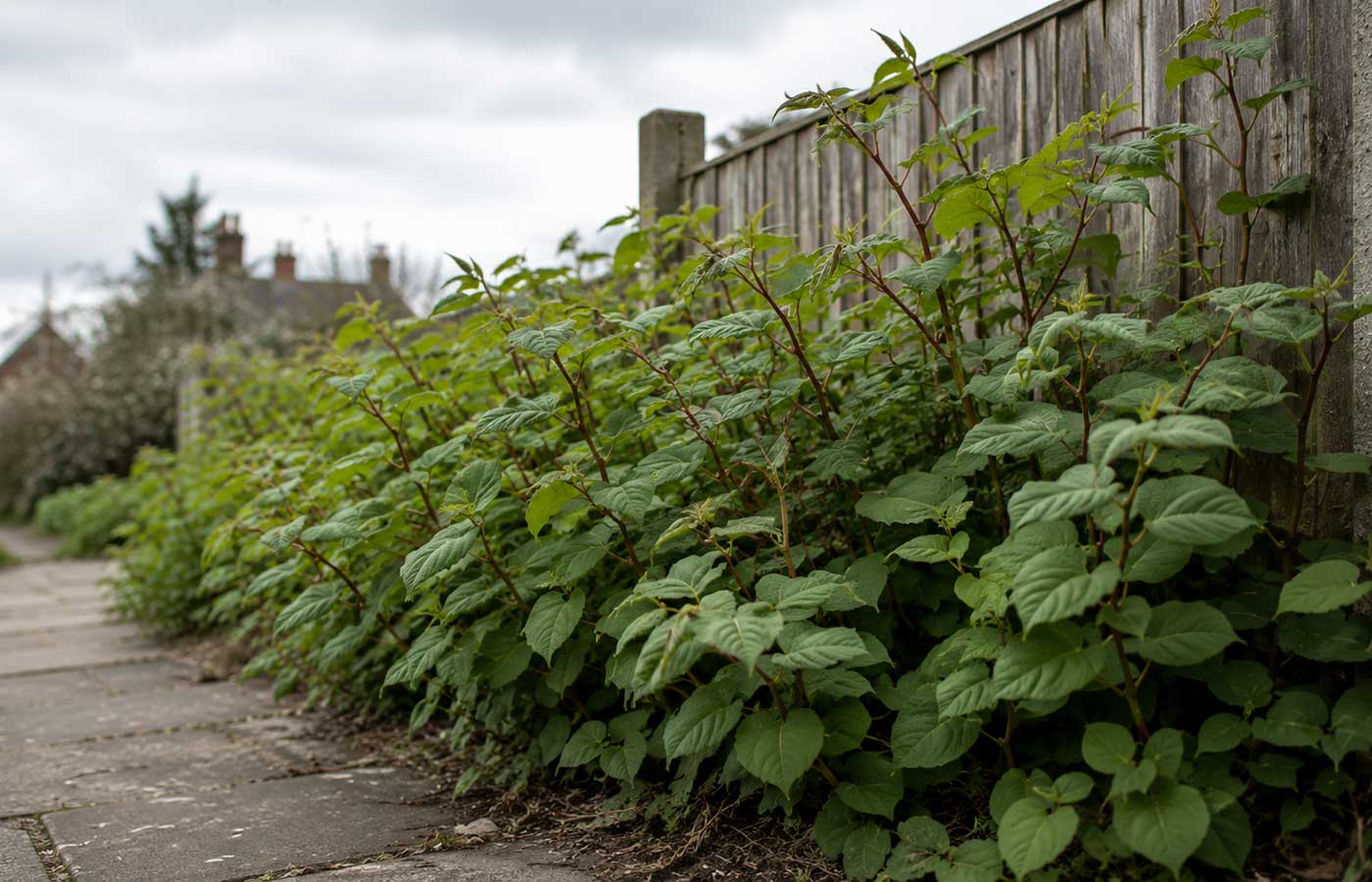
Why so many plants are confused with knotweed
Japanese knotweed changes appearance dramatically throughout the year, which is one reason why identification can become confusing.
Young spring shoots look very different from mature summer growth, while winter knotweed may appear little more than dry hollow canes.
Because of this, many ordinary UK plants end up being compared with knotweed at different stages of growth.
Fast-growing stems, reddish shoots and dense vegetation are usually the features that attract concern first.
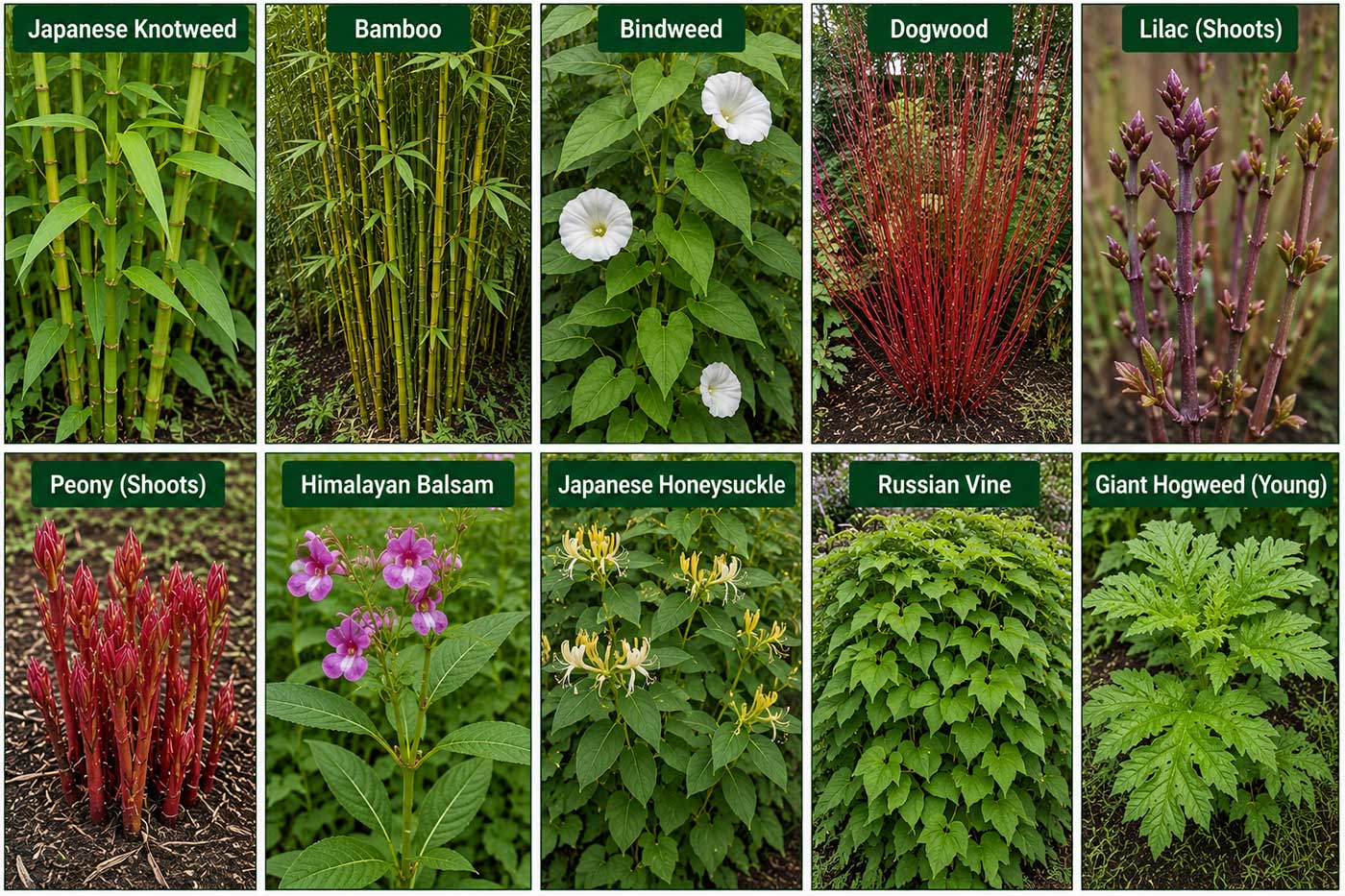
Bamboo is often mistaken for mature knotweed
Bamboo is probably one of the best-known knotweed lookalikes.
People often become concerned after noticing tall cane-like stems growing beside fences or buildings.
Although mature knotweed can resemble bamboo from a distance, the leaves are usually very different.
Bamboo normally has:
- Long narrow leaves
- Woody evergreen canes
- Taller screening growth
- Persistent winter foliage
Japanese knotweed more commonly produces broad leaves and seasonal hollow stems that die back during winter.
Red spring shoots frequently cause alarm
Many knotweed identification worries begin during spring when reddish shoots start emerging from the ground.
Several ordinary garden plants can produce similar growth at this time of year.
Common examples include:
- Lilac shoots
- Peony shoots
- Dogwood growth
- Young bamboo shoots
- Ornamental perennials
Viewed close-up and without leaves, these shoots can sometimes appear surprisingly similar to online knotweed photographs.
Dogwood is commonly confused with knotweed in winter
Dogwood shrubs are widely planted in UK gardens because of their colourful red stems during winter.
When fresh shoots begin appearing during spring, some people mistake the bright red growth for Japanese knotweed.
Dogwood usually forms woody branching shrubs, while knotweed tends to produce thicker upright cane-like stems.
The winter appearance is often one of the clearest differences between the two plants.
Bindweed spreads differently from knotweed
Bindweed is another plant regularly associated with knotweed because both are known for spreading aggressively.
The growth habit is usually very different, however.
Bindweed behaves as a climbing vine that wraps around fences, shrubs and garden structures.
Japanese knotweed normally grows as dense upright vegetation rather than twisting through nearby plants.
Bindweed flowers are also much larger and more obvious than knotweed flowers.
Himalayan balsam can resemble knotweed from a distance
Himalayan balsam is another fast-growing invasive plant that sometimes causes confusion.
It can produce tall dense summer growth beside rivers, streams and damp ground.
However, balsam normally has:
- Pink helmet-shaped flowers
- Softer watery stems
- Narrower leaves
- A different branching structure
The flowers usually make identification easier once the plant matures.
Russian vine and climbing plants can create confusion
Some people compare knotweed with fast-growing climbing plants such as Russian vine.
These plants often spread quickly across fences, sheds and neighbouring vegetation.
Japanese knotweed generally does not climb or twine around structures in the same way.
Instead, it usually produces upright self-supporting stems emerging from the ground in clusters.
Leaf shape is often one of the most useful clues
When trying to compare suspicious plants, the leaves usually provide clearer information than stem colour alone.
Japanese knotweed leaves are commonly:
- Broad and flat
- Shield or heart shaped
- Smooth edged
- Arranged alternately along stems
Many lookalike plants have much narrower, smaller or more pointed leaves.
The time of year often changes identification completely
A plant that appears suspicious during spring may look completely different by summer or winter.
This is one reason why identification based on a single close-up photograph can sometimes be difficult.
Knotweed itself changes significantly through the seasons:
- Red shoots in spring
- Dense green growth in summer
- Flower clusters in late summer
- Dry hollow canes during winter
Many ordinary garden plants go through equally dramatic seasonal changes.
Looking at the whole plant usually helps most
People often focus heavily on one feature, such as a red stem or bamboo-like cane.
In practice, the overall appearance usually matters much more.
Useful things to compare include:
- The full growth pattern
- Leaf arrangement
- Stem structure
- Flowers
- The surrounding location
- Whether the plant climbs or stands upright
Whole-plant photographs in natural daylight normally provide the clearest comparison.
Many suspected plants are eventually identified as something else
Because Japanese knotweed receives so much publicity, many unusual plants automatically raise concern for homeowners.
In reality, a large number of suspicious plants turn out to be ordinary ornamental shrubs, climbers or seasonal garden growth.
Comparing several features together usually provides a far clearer picture than relying on colour or stem shape alone.
Related pages
Having trouble identifying it?
You can send an image of the plant for an initial assessment.